Maji ya moto hayachomi nyumba. (Swahili)
Hot water does not burn down the house. (English)
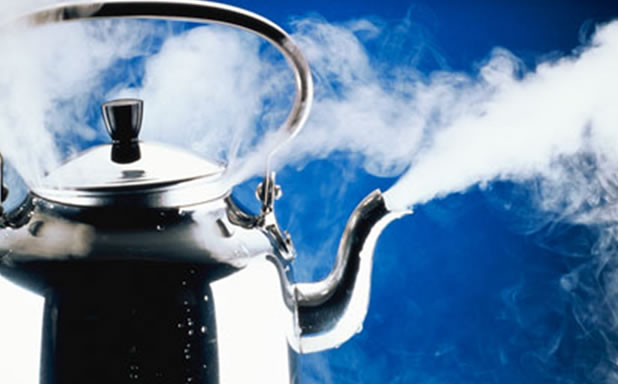
Swahili (Eastern and Central Africa) Proverb
Also Sukuma and Ngoreme (Tanzania), Kuria (Kenya, Tanzania)
Background, Explanation, Meaning and Everyday Use
It does not matter how steaming hot one boils some water. One cannot then pour it on the roof or on any wall of the house and expect any structural damage. Traditionally this Swahili proverb has been used to deny the effectiveness of the strenuous efforts of a lesser person against a greater or stronger one.
In addition however, a man’s “house” is the way he might refer to the place where he and his wife and family live. Talking then of a “house” easily suggests meanings that have to do with marriage and relationships. Some men lodge a second wife or girl friend in a “small house” which connotes a greater degree of stability and commitment there than would a more casual relationship. A man is often proud of the way he builds a house so as to provide adequate shelter against the elements (sun, wind, rain, etc.). A woman is often proud of her contribution or “touch” which shows up in the good order, food and comfort to be found in her “house” or “home”. “Hot water” usually boiled within or around a house readily connotes anger, ill spoken words, or conflicts in general. This proverb then has lent meaning to marriage by placing the more tempestuous aspects of the union within the context of an over-riding intention of stability, promise of fidelity or within the context of a marriage covenant. The “heat” of conflict is thereby rendered less destructive, and inevitable temporary irruptions are less apt to have a permanent effect.
The Sukuma version of this proverb says that arguments between a husband and wife are a normal part of married life. They don’t ruin a marriage. The couple has to work through their problems. A related Sukuma proverb says that The hoes of two people cultivating together in a field clash (hit against each other). Applied to marriage, the proverb means that two people living together are bound to have problems. But these problems do not destroy their marriage. The couple has to work out their difficulties.
 Biblical Parallels
The history of salvation in the Judeo-Christian tradition is a hot, stormy history of the relationship between God and His People. But the “house” of His Love has withstood the “hot water” of disobedience. He gave his word in this history. He called His People. He gave his word in Covenant. He made promises. He sent his Son to complete the reconciliation and assure us of the forgiveness of sins and the stability of the “structure” of His Love. He loved His People not because they were manifestly faithful, but He loved because He decided to love. He built the House of Israel and He pitched his tent among His People, structures that are designed and maintained by His prophetic Word. He intends to stay and to establish solidarity with His People as a possibility without end.
So it is with Christ and the Church. Church people have deserted him often in history but never escaped his presence nor dissuaded him from love.
“I am convinced that neither death nor life, neither angels nor demons, neither the present nor the future, nor any powers, neither height nor depth, nor anything else in all creation, will be able to separate us from the love of God that is in Christ Jesus our Lord” (Romans 8: 39-39). Christian marriage is modeled on this love of Christ and His Church where “hot water does not burn down the house.” A God-like commitment of self to another person has power and longevity over the inevitable squabbles of people who live close together in the same house.
Contemporary Use and Religious Application
Wise people see tragedy more often than not in the context of possibility. Their mental house in life has room in it for unexpected and unsolicited setbacks. We help one another in life not by denying the “hot water” events of our friends, but by affirming their abiding strength and vision. Whatever the “higher power,” it is an invisible but spoken structure that will remain standing through the hot and cold of life. For recovering alcoholics surrender in the presence of an abiding “higher power” provides the structure within which the disease is manageable. Such a “higher power” may well be invisible, but its presence can be known by hearing word of it. In my own experience of training pastoral caregivers, I encourage pastors to find the words with which to construct the “house” or vision that sustains persons in crisis. In its absence persons in crisis are easily overwhelmed by “hot water.” Words of possibility and commitment “contain/hold back” the force of “hot water” events.
Rev. John Eybel, M.M.
Bugando Medical Centre
P.O. Box 10641
Mwanza, Tanzania
EMail: jeybel@bugando.org
situs toto
Related Posts
- Nov. 2001 Proverb: ” When elephants fight the grass (reeds) gets hurt.” – Swahili ( Eastern and Central Africa ), Also Gikuyu ( Kenya), Kuria ( Kenya/Tanzania), Ngoreme (Tanzania)
- October, 2003 Proverb: “The hen with baby chicks doesn’t swallow the worm.” – Sukuma (Tanzania)
- October 2022 African Proverb of the Month One hand does not raise a child. Sukuma (Tanzania) Proverb
- October 2021 African Proverb of the MonthThe monitor lizard has stuck on a rock. Sukuma (Tanzania) Proverb
- October 2019, Even an elephant, that is, an important person, can be sent. Sukuma (Tanzania) Proverb
- October 2018, The salesperson (seller or merchant) does not have only one door. Sukuma (Tanzania) Proverb
- November, 2020 To lose the way is to find the way. Sukuma (Tanzania) Proverb
- May 2010: “Tomorrow makes known to us what tomorrow will bring” – Sukuma (Tanzania) Proverb
- March, 2015 A good person (goes to God) with his or her clothes?” … “Potato.” Sukuma (Tanzania) Riddle
- Mar. 2012: “Look up, Tungu my child.” ~ Sukuma (Tanzania) Proverb
- June, 2024 African Proverb of the Month If you have someone leading you, you cannot lose the way. Sukuma (Tanzania Proverb)
- June, 2023 African Proverb of the MonthLearning has no end. Sukuma (Tanzania) Proverb
- June, 2017 There is no rush. Take it easy. Sukuma (Tanzania) Saying
- June 2020, Goat droppings (that later become manure) are mainly found in a loafing shed (barn). Sukuma (Tanzania) Proverb
- June 2019, An elephant is not overwhelmed by its trunk. Sukuma (Tanzania) Proverb
- Jun. 1998: “I pointed out to you the stars (the moon) and all you saw was the tip of my finger.” – Sukuma (Tanzania) Proverb
- July, 2021 African Proverb of the MonthThe way is in the mouth.Sukuma (Tanzania) Proverb
- Jul. 2000 Proverb: ” Do not insult the hunting guide before the sun has set.” – Sukuma (Tanzania)
- January, 2020 Although he is materially poor, at his house was found a housefly cord. Sukuma (Tanzania) Proverb
- January 2023 African Proverb of the Month A nice potato is never peeled Sukuma (Tanzania) Proverb
- January 2018 To make marks on the trees. Sukuma (Tanzania) Proverb/Story
- Jan. 2008: “I have been bitten by a tsetse fly.” – Sukuma (Tanzania) Proverb
- Jan. 2007: “Two ants do not fail to pull one grasshopper.” – Haya (Tanzania) Proverb
- February, 2024 African Proverb of the MonthCome back child.Sukuma (Tanzania) Proverb
- February, 2022 African Proverb of the MonthThe one who leads (usually in a herd of cattle) drinks clean and clear water. Sukuma (Tanzania) Proverb
- February-March, 2021 The pursuit of grasshoppers is done in the morning. Sukuma (Tanzania) Proverb
- February 2025 African Proverb of the Month Having white hair is a broom Sukuma (Tanzania) Proverb
- February 2023 African Proverb of the Month Stumbling is not falling but going forward. Sukuma (Tanzania) Proverb
- February 2019, The medicine for a rising river is to go back. Sukuma (Tanzania) Proverb
- February 2014 – The hoes of two people cultivating together in a field sometimes clash (hit) against each other. Sukuma (Tanzania) Proverb
- February 2013 – As soon as you experience hunger pangs (feel hungry) why do you always want to eat? Sukuma (Tanzania) Proverb
- December, 2023 African Proverb of the MonthMiss a target when hunting, rather than marry the wrong woman.Sukuma (Tanzania) Proverb
- December, 2021 African Proverb of the MonthThe ant tried/made an effort to eat the rock (stone).Sukuma (Tanzania) Proverb
- August, 2023 African Proverb of the MonthToday is today whoever says tomorrow is a liarSukuma (Tanzania) Proverb
- August 2025 African Proverb of the Month The rhinoceros that has babies is not bitten on her legs. Sukuma (Tanzania) Proverb
- August 2022 African Proverb of the Month Many pieces of firewood light the whole night.Sukuma (Tanzania) Proverb
- April 2025 African Proverb of the Month If it is not broken don’t fix it. Sukuma (Tanzania) Proverb
- April 2023 African Proverb of the Month The grinder of sorghum sings to comfort herself . Sukuma (Tanzania) Proverb
- April 2022 African Riddle/Story of the Month“I have a riddle.” “Let it come.” A person went to the coast naked and came back/returned fully clothed?… groundnut/peanut.Sukuma (Tanzania) Riddle/Story
- Apr. 2011: “To stay a long time in the water does not make you clean.” – Sukuma (Tanzania) Proverb
- Sep. 2007: “Where there’s a will there’s a way.” – Swahili (Eastern and Central Africa) Proverb
- October 2026 African Proverb of the Month Even if the back of the head grows, it will never pierce through the hat. Sukuma (Tanzania) Proverb
- November — December 2024 African Saying of the Month You will get burnt. Swahili (Eastern and Central Africa) Saying
- Mar. 2005: “How are things? Cool! ” – Swahili (Eastern and Central Africa) Proverb
- Mar. 2000 Proverb: “If you refuse the elder’s advice you will walk the whole day.” – Ngoreme (Tanzania)
- Mar. 1999: “Let the guest come so that the host or hostess may benefit (get well).” – Swahili (Eastern and Central Africa) Proverb
- June-July 2026 African Proverb of the Month They are about to burn the fresh (wet) firewood, what will happen to the dry ones Sukuma (Tanzania) Proverb
- Jul. 1999: “Better a curtain hanging motionless than a flag blowing in the wind.” – Swahili (Eastern and Central Africa) Proverb
- February 2026 African Proverb of the Month You have fled from the rain, can you flee from the dew too? (Sukuma) Proverb
- April 2026 African Proverb of the Month It flashes, it will rain Sukuma (Tanzania) Proverb