Opening a Door on African Theology and Music. Portrays the story of Father Don Sybertz, MM and life and ministry of Ndoleleji Research Committee in Shinyanga, Tanzania. Ndoleleji, Tanzania: YouTube Website, 2011. 8:01 minutes.
Category: Resources
Research and Writing on Sukuma Culture and Oral Literature in Tanzania is Alive and Well!
In the last year we have seen the resurgence of research and writing on Sukuma Culture and Oral Literature in Tanzania. Here are some examples:
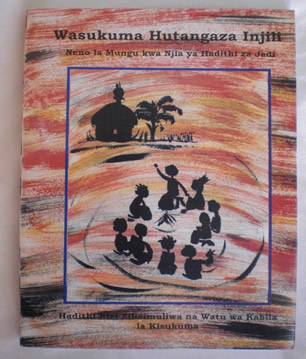
1. Wasukuma Hutangaza Injili (The Sukuma People Announce the Gospel). 71 stories from the Sukuma People as collected and commented on by Catechist Joseph Nkumbulwa and Father Pascal Durand M. Afr. (Mwanza, Tanzania: KTN Printing Press, 2010).
2. Kalenda ya Kisukuma 2011. Using Sukuma proverbs.
3. Write-up of two Sukuma Proverbs to be posted as future “African Proverbs of the Month” on our website.
4. “Three Case Studies of African Christology among the Sukuma People in Tanzania” by Joseph Healey. This article was originally presented as a 20-minute talk at the Pan African Conference of the Association of African Theologians (AAT) at the Catholic University of Eastern Africa (CUEA) in Nairobi, Kenya on 9 November, 2010. A longer text will be published in the “Proceedings” of the conference in an AAT book called The Church in Africa Fifty Years after States’ Independence. The full text will be published in the 2011/1 issue of the Tangaza Journal of Theology and Mission, a journal of the School of Theology of Tangaza College in Nairobi, Kenya. Presently online on our website at: http://www.afriprov.org/index.php/bibliography/575-three-case-studies-of-african-christology-among-the-sukuma-people-in-tanzania.html
5. Father Donald Sybertz and the Ndoleleji Research Committee in Shinyanga Diocese in Shinyanga, Tanzania continue to write a lengthy theological interpretation of the creation myth Tears of Joy: African Story about Heroes and Monsters, the Sukuma story of the young man Masala Kulangwa and the monster Shing’weng’we that is part of a long Sukuma song. Presently they are comparing the Mother of Masala Kulangwa and the Mother of Jesus Christ.
6.The Maryknoll Magazine, based in Maryknoll, New York, USA is completing two projects:
a. A short video on Father Donald Sybertz and the Ndoleleji Research Committee called “Opening a Door on African Theology and Music” to be posted on the magazine website.
b. An article “Don Sybertz Opens a Door to African Theology” by Sean Sprague.

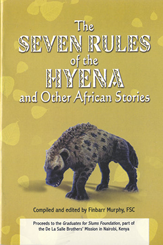
Compiled and edited by Finbarr Murphy, FSC
Nairobi, Kenya: Paulines Publications Africa, 2010.
174 pages. Paperback.
Price: $9.
An anthology of 20 contemporary African stories, this book holds the mirror up to the ongoing conflict between traditional African beliefs and an often over-westernised version of Christianity. The title story argues that this century belongs to Africa whose cohorts of graduates from Cape to Cairo are already staking their claim. In “Touch”, Petronilla Kidakwa revisits a time-honoured Luhya marriage custom, sadly forgotten by many urbanized Kenyans, while in contrast, “The Love Potion” seems to celebrate — or lament — a dubious Kamba tradition. Two other contrasting stories are the “Rite to Name” whose hero is Owino Ochieng and “Over the Mountain”, whose ’shero’ is American-educated Dr Maria Macharia in whom there’s not even a shred of religious dualism.
“This book should be in every library” – East African Theologian, Rev Laurenti Magesa.
The book is available by e-mail from distribution@paulinesafrica.org
***
This article was originally presented as a 20-minute talk at the Pan African Conference of the Association of African Theologians (AAT) at the Catholic University of Eastern Africa (CUEA) in Nairobi, Kenya on 9 November, 2010. The text was published in the “Proceedings” of the conference in an AAT book called The Church in Africa Fifty Years after States’ Independence. An enlarged, updated text was published in the 2011/1 issue of the Tangaza Journal of Theology and Mission, a journal of the School of Theology of Tangaza University College in Nairobi, Kenya.
Three Case Studies of African Christology among the Sukuma People in Tanzania
Wasukuma Hutangaza Injili (The Sukuma People Announce the Gospel)
71 stories from the Sukuma People as collected and commented on by Catechist Joseph Nkumbulwa and Father Pascal Durand M. Afr.
(Mwanza, Tanzania: KTN Printing Press, 2010).
This book in Swahili of 168 pages aims at offering a view into the traditional narratives of the Sukuma People, the largest ethnic group within Tanzania. It is composed of 71 traditional Sukuma stories, divided into four different chapters: stories on cleverness, stories on envy, stories on salvation and stories on love. Each story is transcribed as close as possible from the collected original narrative. A few of these stories had already been published, and the references are provided. The narration is completed by some invitation to draw parallels from stories of the Bible. The Biblical references together with the general frame of the book, gently invite the reader to acknowledge that there will always be ways to tell the stories in order to get closer to God and to His Love, a Love which emerges in the last chapter as a general conclusion for the whole book.
***
Recueil de 71 histoires traditionnelles Sukuma collectées et commentées par le Catéchiste Joseph Nkumbulwa et le Père Pascal Durand M. Afr.
(Mwanza,Tanzanie: KTN Printing Press, 2010).
Ce livre en Swahili de 168 pages a pour but d’offrir au lecteur une entrée dans l’univers narratif traditionnel du peuple Sukuma, le groupe ethnique le plus important en Tanzanie. Ce livre est composé de 71 histoires traditionnelles, divisées en quatre chapitres : la ruse, l’envie, le salut et la générosité. Chaque histoire est transcrite au plus près possible de la narration originelle, qui a parfois déjà été publiée et les références sont données. Les narrations sont suivies par des invitations à penser des parallèles tirés de la Bible. Les références bibliques proposées ainsi que le plan général du livre propose au lecteur l’idée selon laquelle il sera toujours possible de raconter ces histoires afin de cheminer plus près vers Dieu et vers son Amour, un Amour qui émerge dans le dernier chapitre comme la conclusion générale du livre.
Price : 5,000/= Tanzanian Shillings. Availablefrom the author, Pascal Durand, at: pascalbcd@yahoo.fr
Ten Years of the Caine Prize for African Writing:
Plus Chinua Achebe, J.M. Coetzee, Nadine Gordimer, and Ben Okri
New Internationalist Publications (Oxford, United Kingdom), 2009.
228 pages. Hardcover.
Price: $18.95 (US), £ 9.99 (UK)
Reviewed by PAULINE ODHIAMBO
This book is an intriguing compilation of 14 short story excerpts by winners of the Caine Prize for African Writing founded in 1999. Binyavanga Wainaina, Yvonne Adhiambo Owuor and Monica Arac de Nyeko are among writers from East Africa to have won the prize since its inception. Nigerian writers Helon Habila, the 2001 winner and E.C Osondu, winner of the 2009 prize have both written quite interesting stories and as soon as one reads their opening lines it becomes rather obvious as to why they were shortlisted and awarded the prize.
In his story titled Waiting, Osondu captures the tragedy and desperate innocence of two young boys named Acapulco and Orlando who end up living in a camp due to the ravages of war. The following is an excerpt from the story: “There were lots of black dogs (in the camp). They were our friends, they were our protectors. Even though food was scarce, the dogs never went hungry. The women would call them whenever a child squatted down to shit and the dogs would come running. They would wait for the child to finish and lick the child’s buttocks clean before they ate the shit. But there was a time the Red Cross people could not bring food to the camp for two weeks because the enemy would not let their plane land. We were so hungry we killed a few of the dogs and used them to make pepper-soup. A few days later, the Red Cross people were let through and food came. The dogs were a bit wary, but they seemed to understand it was not our fault. And then, for a second time, there was no food for a very long time. We were only able to catch some of the dogs this time but we still caught some and cooked and ate them. After that we did not see the dogs again. One day, a little child was squatting and having a shit. When the mother looked up, half a dozen of the dogs that had disappeared emerged from nowhere and attacked the little child. They tore the child to pieces and fled with parts of the child’s body dangling between their jaws. Some of the men began to lay ambush for the dogs and killed a few of them. We don’t see the dogs anymore. People say it is the war.”
This book also includes excerpts from Ben Okri, Nadine Gordimer and J.M Coetzee, all awarded the Booker Prize for their writing. Jambula Tree by Monica Arac de Nyeko and Incidents at the Shrine by Ben Okri painted vivid pictures of the dynamics of African sexuality and witchcraft. Weight of Whispers by Yvonne Adhiambo Owuor is a heart-rending account on the tribulations of a Rwandese family in Kenya after a narrow escape from the Rwandan genocide whereas Poison by South African writer Henrietta Rose-Innes would have been a rather depressing and boring story if weren’t so well-written. An Emissary by Nadine Gordimer is one excerpt in this book that readers may find a tad confusing as it reads more like complex poetry and less like a short story as compared to other excerpts in the book.
A possible favourite in this book would be Love Poems by Helon Habila and the following is an excerpt: “My anger lasted a whole year. I remember the exact day it left me. It was a Saturday, a day after a failed escape attempt by two convicted murderers. The warders were more than usually brutal that day; the inmates were on tenterhook, not knowing from where the next blow would come. We were lined up in rows in our cell, waiting for hours to be addressed by the prison superintendent. When he came his scowl was hard as a rock, his eyes were red and singeing, like fire. He paced up and down before us, systematically flagellating us with his harsh, staccato sentences. We listened, our heads bowed, our hearts quaking. When he left, an inmate, just back from a week in solitary, broke down and began to weep. His hands shook, as if with a life of their own. “What’s going to happen next?” he wailed, going from person to person, looking into each face, not waiting for an answer. “We’ll be punished. If I go back there I’ll die. I can’t. I can’t.” Now he was standing before me, a skinny mass of eczema inflammations, and ringworm, and snot. He couldn’t be more than twenty. I thought, what did he do to end up in this dungeon? Then, without thinking, I reached out and patted his shoulder. I even smiled. With a confidence I did not feel I said kindly, “No one will take you back”. He collapsed into my arms, soaking my shirt with snot and tears and saliva. “Everything will be all right,” I repeated over and over. That was the day the anger left me”.
No doubt, this book would make a worthy collectors item. A thoroughly enjoyable read indeed.
Published in “The Star” Newspaper
Nairobi, Kenya
December, 2009
—————————————————————————————————————
How to order :
- Click on the cover to the right or HERE to order directly from Amazon.com.
- For online ordering New Internationalist Publications has a number of secure online shops and customer service centres worldwide. Click one of the following links for your nearest shop — Australia, Canada, New Zealand/Aotearoa, UK and USA.
- You can also place your order via telephone through one of the New Internationalist Publications customer service centres:
Australia: +61 (0)8 8232 1563
Canada: +1 416 588 6478
New Zealand/Aotearoa: +64 (0)3 386 3153
UK: +44 (0)1709 513999